How is the hidden danger of heating of electrical equipment in operation analyzed by infrared thermal imaging detection?
With the development of economic construction and the improvement of people's living standards, the number of various electrical equipment is increasing day by day, the power supply load is increasing, and some electrical equipment is operating under overload or age.
Therefore, in the safety inspection, electrical safety testing of electrical equipment and lines, determining the existence and severity of electrical faults, and taking timely measures to eliminate hidden dangers can effectively prevent and reduce the occurrence of electrical accidents. Infrared detection technology is an important means of electrical safety testing.
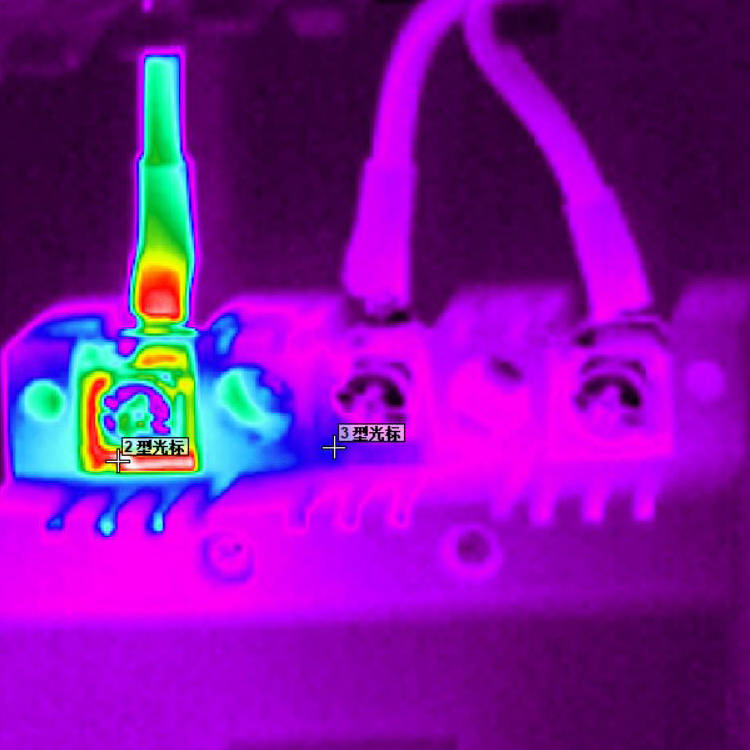
Infrared detection technology is an emerging comprehensive technology developed based on infrared physics, infrared optoelectronics and electronic computers, which is widely used in military, metallurgy, electric power, petrochemical, medicine and other fields. In recent years, NK handheld infrared thermal imaging detection, online infrared red array thermal monitoring NKTEVA6 monitor to monitor electrical components and joints in switchgear, NK drone-type infrared thermal imaging to detect power transmission and distribution lines, NK tunnel mobile infrared thermal imaging monitoring cable, in electrical safety detection, find electrical hidden dangers, prevent and prevent electrical accidents have also achieved remarkable results.
We know that electrical equipment will heat up during normal operation, and the process of formation and development of electrical faults is mostly related to heating and heating. In the process of using electrical equipment, there are a large number of joints, contacts or connectors in the conductive circuit part, if the connection of the conductive circuit fails, it will cause the contact resistance to be too large, and when the load current passes, it will inevitably lead to local overheating; If the insulation layer of electrical equipment is aging or damaged, it will cause excessive loss of insulating medium, and overheating will occur under the action of operating voltage. In addition, arbitrary installation of electrical equipment will also cause the wire to overheat due to excessive ampacity, and these overheating places will become a hidden danger to electrical safety.
How is the hidden heat hazard of running electrical equipment detected by infrared thermal imaging?
Electrical hazard detection and judgment methods
Infrared detection technology is mainly used to detect and determine overheating hazards.
Detection of electrical hazards
The detection process of electrical hazards generally consists of four steps:
(1) Use infrared thermal TV or thermal imaging camera to conduct a comprehensive scan and general inspection of general electrical equipment and circuits, and find abnormal heating parts. Thermal images are taken for the heating parts of key electrical equipment and lines;
(2) Use an infrared thermometer to measure the temperature of the abnormal heating area. When measuring temperature, the surface emissivity of the measured object should be correctly selected, the appropriate reference object should be selected to determine the ambient temperature, and the compensation parameters such as ambient temperature, relative humidity and measurement distance should be typed and the appropriate temperature range should be selected.
The temperature value of the highest hot spot should be measured from different directions for the same measurement object, and the distance and orientation should be consistent when measuring the temperature of different measurement objects.
(3) Record the actual load current, surface temperature and ambient temperature of the heating part of the abnormally heated electrical equipment;
(4) Use a computer to analyze and process the temperature field of the thermal image.
How to determine electrical hazards
Temperature judgment method
According to the surface temperature of the heating part of the electrical device measured by the infrared thermal imager, the possible electrical hazards are analyzed by considering the load factor and the contact resistance of the connecting part.
This method is proposed to eliminate the influence of different loads and ambient temperatures on the infrared judgment results. When the ambient temperature is low, especially when the load current is small, the temperature value of the equipment does not exceed the specification standard, but a large number of facts prove that the temperature value at this time does not mean that the equipment has no defects or faults. Therefore, the "relative temperature difference" method can also be used to determine whether there are hidden dangers or not.
"Relative temperature difference" refers to the ratio of the temperature difference between two corresponding measuring points with the same or substantially the same equipment condition (referring to the equipment model, installation site, ambient temperature, surface condition and load current, etc.), and the temperature rise of the hotter measuring point, and its mathematical expression is
Δτ(%)=(τ1-τ2)/τ1×100(%)(3)
Among them:
τ1 - temperature rise at the higher temperature measurement point, (°C);
τ2 - temperature rise at the lower measuring point, (°C).
Usually, when the δτ ≥ 35%, the defect of the equipment can be diagnosed, and it should be tracked and monitored, and planned maintenance should be arranged if necessary.
Similar comparison method
The so-called "similar" equipment refers to the same type of equipment in the same circuit and the three phases of the same equipment, that is, the same type of equipment when their working conditions and ambient temperature are comparable, usually called "vertical comparison" and "horizontal comparison". The specific method is to compare the temperature values of the corresponding parts of similar equipment, which can easily judge whether the equipment is normal. When making similar comparisons, it should be noted that the possibility of thermal failure in three-phase equipment cannot be ruled out, although the probability of this occurring is quite low. The comparative method has a wide range of applications, including current and voltage equipment, as well as the diagnosis of internal and external faults.






 Support
