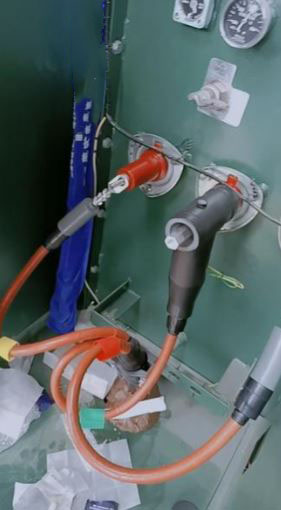
What is the waterproof bend that the engineering enthusiasts are talking about? What is the mechanism of action?
In various box transformers, switchgear, and switchgear, most use cable down-entry wire structures. When it rains, water does not "flow up" on its own but is adsorbed onto the cable sheath and gradually climbs upward.
1. The real reason: not water flow, but water film + capillary + surface tension
You can think of the cable sheath as a wet rope:
- Rain, condensation, ditch moisture → The outer skin is covered with a water film
- The water film is continuous, not drop-by-drop
- Due to surface tension, water spreads upward along the outer skin
- With the addition of wind pendulum and vibration, the water will climb higher and higher
The result was:
The cable enters the cabinet from bottom to top→ and the water film climbs all the way up to the terminal terminal
2. The downstream line structure is naturally designed to "divert water uphill"
The lower incoming line looks like this:
- Cable trenches/ground (low)
- → Vertical upward
- → Access to high-voltage cabinets/transformers (from high places)
The cable sheath is a continuous slope, allowing the water film to climb along the slope all the way to the high-voltage terminal.
Gravity does make water want to fall down, but surface tension + capillary action is stronger and can hold the water upward.
3. Why is high voltage especially wary of this?
Low-pressure inlet water is prone to electric leakage and tripping;
Once a continuous water film is formed under high pressure, it is equivalent to:
A conductive path is laid directly on the insulated outer shell
High-voltage electricity follows this waterway
From cable terminals → water film → cabinet/grounding → creepy, flashover, and firing systems
4. What exactly is a waterproof curve for?
To make a U-shaped/inverted U-shaped drip bends, it is:
- Interrupt the continuous waterway
- Let water gather at the lowest point of the bend into droplets
- Water droplets are too heavy, surface tension cannot hold the water
- Directly drip it down
If water can't climb up, the high voltage can't carry the water to the electricity.
The reverse water bend of a cable joint (also called waterproof bend or drip bend) is a deliberately downward (or upward) curved or angular bend made near the cable joint. Its core function is to block water from flowing along the cable sheath into the joint, terminal, or inside the equipment, preventing short circuits, rust, and electric leakage.
1. Core Principles
Water flows down along the surface of the cable sheath.
The reverse water bend forms the lowest point; water flows here naturally drip and cannot flow upward beyond the bend.
Essentially, it is a physical water cutoff, similar to a drip line under an eaves.
2. Standard Practice (Must be done outdoors / in humid scenes)
1. Location: About 15–30cm below the connector / equipment inlet
2. Shape: U-shaped or Ω-shaped bent downward (lowest point below connector/terminal)
Key points
o Bending radius complies with cable specifications (does not damage insulation)
o Firmly fixed after bending, no deformation or rebound
o Seal the pipe opening with sealing putty / waterproof tape
3. Role (Why It Must Be Done)
Water ingress prevention: rainwater and condensate must not flow into connectors or terminals
Corrosion resistance: Prevents joints from prolonged water immersion, oxidation, or heat burning
Leakage / Short Circuit Prevention: Keep joints dry to enhance insulation and safety
4. Common scenarios
Outdoor box transformers and distribution cabinets
Wiring motors, pumps, and outdoor equipment
Cable trays, wall-penetrating pipe openings, and underground well joints
Outdoor electrical equipment such as photovoltaics, charging stations, and street lights
Additionally, NKTEVA6 monitoring devices are installed inside the box transformer, equipped with built-in water sensors, cable flood alarms, and timely drainage for engineering personnel
It allows video capture to observe internal cables and connectors, and can also monitor whether cables and connectors are overheating
The intelligent distributed red array monitoring detector NKTEVA6 cable flood alarm comes with supporting software
The new version adds a flood alarm function (with built-in water immersion sensor), and a 90-degree red array field of view
Wide field of view makes it ideal for monitoring inside transformers/high and low voltage cabinets, as well as fire and fire monitoring in cable tunnel integrated utility tunnels
Red Array video can be recorded and captured
The new Red Array offers a wider viewing angle of 90 degrees
Grid-powered / POE-powered fixed installation
Red Array has a faster response speed
A single upper computer workstation can run multiple monitoring software sets simultaneously
Online Kuajie Browsing
Windows computer, ANDROID phone
Mobile browsing is faster
TS501-94 distributed red array detector
TS501-95 Red Array controller 8-port / 16-port
.jpg)
Comes with built-in LEDs
NKTEVA6 Instructions for Using the Distributed Red Array Detector Monitoring Software 2025 Edition
No software installation required, does not occupy the registry, is safer, uses less system resources, runs faster and runs immediately after extraction
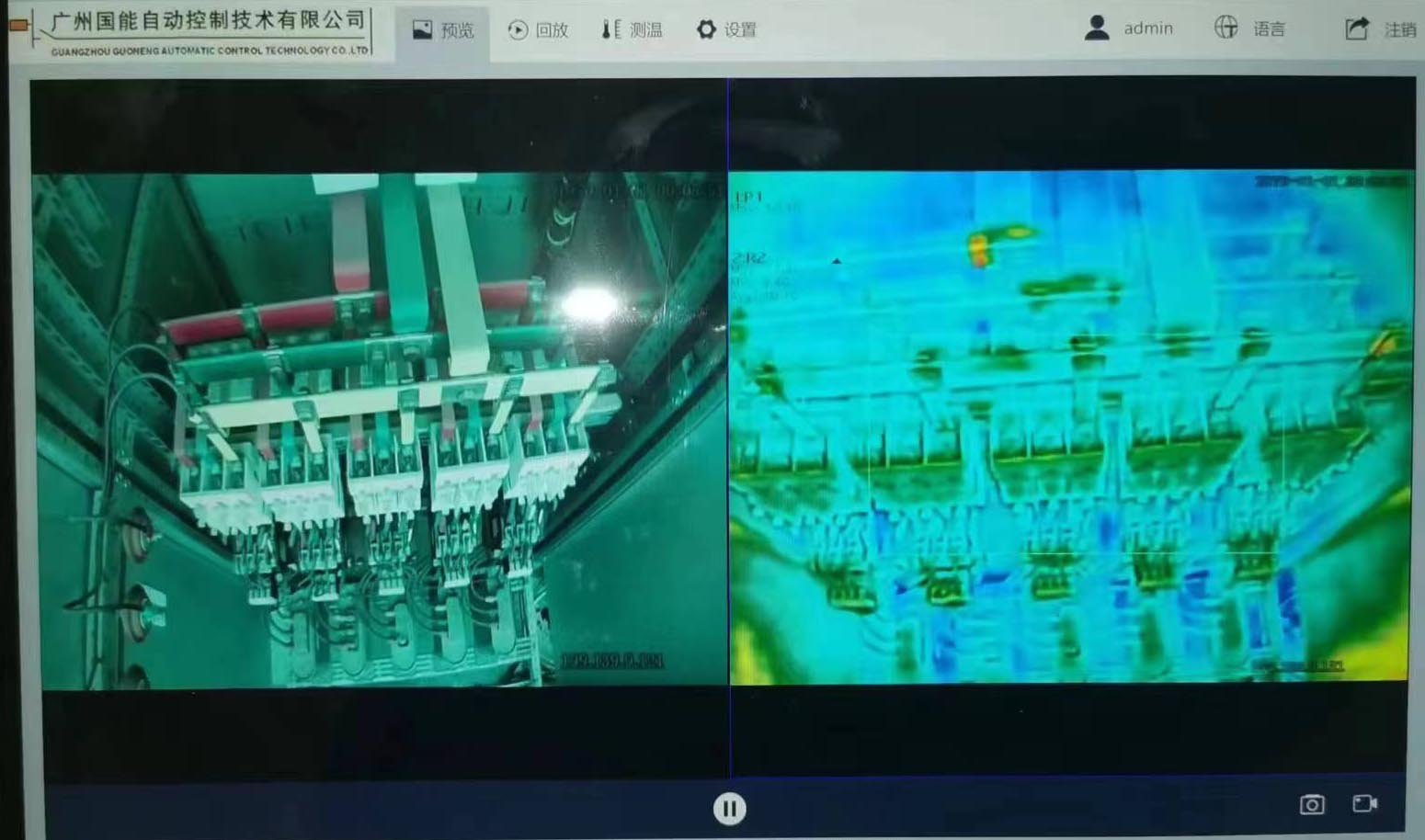
1 Red Array monitoring graphical management software 1 set Over-temperature alarm and cable flood alarm
(One host computer workstation can install multiple software packages and run simultaneously)
2 Red Array Controller NKTP 1 unit . Each NKTP Red Array controller has up to 24 RJ45 ports for power supply and communication
3 Distributed Red Array Detector NKTEVA6 1 unit Built-in water seepage sensor, 256 × red array detector 192. Field of view 90 degrees
(Supports browsing and settings on Windows computers and ANDROID phones)
Real-time capability, continuity, and a more user-friendly RJ45 network power interface make wiring simpler and relatively safer
It is very suitable for large-scale network systems
Wide field of view makes it ideal for monitoring inside high and low voltage cabinets as well as fire and fire monitoring in cable tunnel integrated utility tunnels
Providing advanced red array detection temperature imaging video monitoring solutions for on-site condition monitoring:
Equipped with a brand-new VOx detector to distinguish more details; 25Hz frame rate network interface; More advanced Matrix III image algorithm;
Reduces size and power consumption, making installation easier; Compatible with multiple industrial protocols, easily enabling automatic alarms and compatible with power monitoring SCADA interconnection






 Support